
This equipment should no longer be viewed as isolated systems but as true Security Information Systems (SIS), whose availability, integrity, and control are essential to the security of people, property, and operations.
In this context, cybersecurity is a major challenge. It must be integrated from the project design phase and taken into account throughout the systems’ lifecycle.
This evolution marks a profound transition: the security system, which once consisted of juxtaposed equipment, is now becoming a full-fledged security information system, whose security must be designed, governed, and monitored with the same rigor as any critical information system.

Our APSAD R81 and R82 certifications incorporate the cybersecurity requirements of the APSAD D32 standard, the CNPP’s benchmark for the cybersecurity of safety systems connected to IP networks.
This approach helps, in particular, to:
• control access to equipment and platforms;
• secure data exchanges and data flows;
• implement appropriate network segmentation;
• apply best practices for configuration and maintenance;
• limit the systems’ exposure to digital threats.
This security foundation enables us to meet the requirements of numerous safety projects while ensuring a level of protection appropriate to the identified risks.

For these environments, Eryma implements a reinforced cybersecurity approach that includes, in particular:
• risk analysis;
• the principles of Security by Design;
• the design of secure architectures;
• advanced segmentation and traffic isolation;
• the implementation of dedicated firewalls;
• secure system administration;
• monitoring and traceability of actions;
• vulnerability management;
• maintenance of security posture;
• management and handling of security incidents.
This approach can be based on ANSSI recommendations, applicable regulatory requirements such as NIS2 when the context requires it, as well as the specific constraints of our clients and their operating environments.
The goal is to secure not only the security equipment but also the entire Security Information System that supports it.

At Eryma, cybersecurity is taken into account from the planning and design phases onward to integrate security requirements as early as possible into the project.
This approach makes it possible to:
• anticipate risks;
• reduce the attack surface;
• limit future remediation costs;
• improve the overall resilience of the infrastructure;
• facilitate the long-term operation and maintenance of the systems.
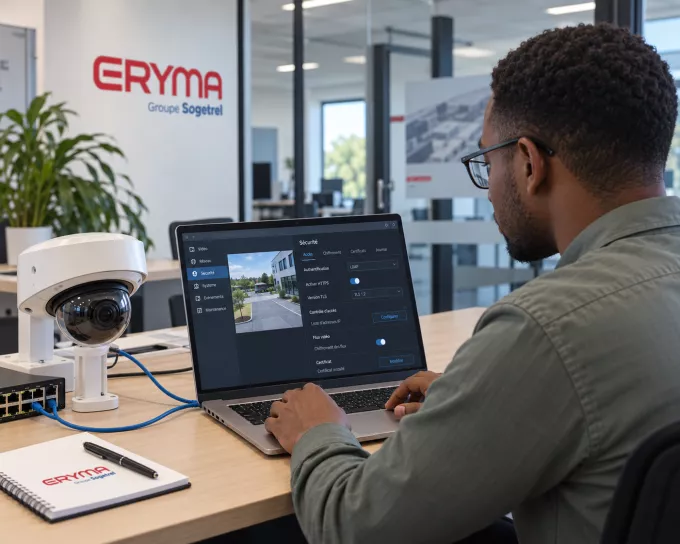
Eryma develops a culture of vigilance through:
• regular awareness campaigns;
• tracking cybersecurity training and modules;
• dedicated training programs;
• the use of ANSSI educational resources;
• ongoing initiatives aimed at reinforcing best digital practices.
This approach helps maintain a high level of cyber risk management within the company.

Beyond individual expertise, Eryma is progressively strengthening its internal organization to develop its capabilities in providing support, monitoring, processing, and coordinating cybersecurity matters as they relate to safety systems.
As a company in the Sogetrel Group, Eryma is involved in a comprehensive information security initiative.
The Group’s certifications and commitments, particularly ISO 27001 and CyberVadis, contribute to the implementation of best practices in governance, information protection, and continuous improvement.
This approach enables Eryma to capitalize on a mature and structured ecosystem to support its clients in addressing their cybersecurity challenges.
Why has cybersecurity become essential in safety systems?
Safety systems today are connected to organizations’ networks and digital infrastructure. As a result, they may be exposed to the same threats as other information systems: compromised credentials, exploitation of vulnerabilities, malware, or service disruptions.
What is the APSAD D32 standard?
The APSAD D32 standard is a CNPP standard dedicated to the cybersecurity of safety systems connected to an IP network. It defines recommendations and requirements for integrating cybersecurity into the various phases of a project.
What is the difference between a standard project and a sensitive project ?
All projects benefit from a cybersecurity foundation that is integrated into Eryma’s methodologies. For environments with higher-risk profiles, additional measures may be implemented based on the context, risks, and client requirements.
How does Eryma support its clients on cybersecurity issues?
Our teams get involved as early as the design phase to integrate cybersecurity into the system architecture, and then support clients in the areas of operations, security maintenance, and risk management.
What standards can be considered for the most demanding projects ?
Depending on the project's needs, Eryma can refer to ANSSI recommendations, applicable regulatory requirements, industry best practices, and the security constraints specific to each organization.